Over 150 hectares of sugarcane fields have been destroyed in Cameroon due to violent clashes between workers at the Société Sucrière du Cameroun (SOSUCAM) and police. The unrest, which erupted earlier …
FIFA has announced the immediate suspension of the Congolese Football Federation (FECOFOOT), following escalating tensions between the Ministry of Sports and the football body. The dispute, which has been ongoing for …
A federal judge has delivered a major blow to President Donald Trump and his ally, billionaire Elon Musk, halting plans to pull thousands of staffers from the U.S. Agency for International …
The Oyo State Police Command, on Saturday, August 22, announced the arrest of a trader identified as Emmanuel Egbu, for allegedly eating human excreta with bread. Africanewsguru garnered that the Police Command …
The Oyo State Police Command, on Saturday, August 22, announced the arrest of a trader identified as Emmanuel Egbu, for allegedly eating human excreta with bread.
Africanewsguru garnered that the Police Command detained Egbu at Ibadan, the State Capital, after being caught in the act by neighbours.
It was further reported that this situation caused a huge traffic gridlock as people trooped our to catch a glimpse of the scenario.
Eating human excreta is said to be the hallmark of Internet fraudsters; who also combine money rituals with cyber fraud.
Egbu, who runs a successful cosmetics business in Sango area of the city; was alleged to have been caught eating an admixture of human excreta and bread before his arrest.
Those who caught him with the weird food combination were said to have raised the alarm; which attracted a huge crowd.
However, he was rescued before he could be lynched; by the Police who transferred him to the Sango Police Station.
The Police Public Relations Officer in Oyo State, Mr Olugbenga Fadeyi, when contacted explained that Egbu was in police custody.
He said the Divisional Police Officer in charge of Sango Police Station had begun investigation into the incident.
The PPRO said, “The DPO told me that some people rescued the man from those who accused him of eating excreta and bread. They said they found some excreta which he packed inside a nylon bag. He was caught and taken to the police station.
“The DPO has taken over the case and the man is already in custody. He has begun investigation into the case; and samples of what was found on him would be sent for laboratory analysis.
“He has taken the man’s statement also, and after the investigation at that level; the case will be sent to the State Criminal investigation Department at Iyaganku for further investigation. Investigation will reveal if he is involved in money ritual or not.”
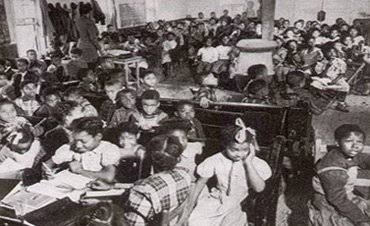
The begining of colonization and the beginning of education in South Africa can definitely not be utterly separated, as the experiences are interwoven.
The time of the foundation of the colonial experience at the Cape in 1652 was the same as the beginning of education in South Africa. Six years after, the Dutch East India Company established its colony at the Cape, the first formal school is begun in 1658. This school was founded by Commander Jan van Riebeeck for the slave children brought to the Cape in the Dutch ship, the Amersfoort, which had captured them off a Portuguese slaver.
For two reasons, extremely significant is the establishment of the first school in the history of South Africa. Firstly, this school had many of the characteristics that have come to frame the South African experience. It was profoundly oppressive. As the slave children are enrolled, so they are forced to take new identities. Nothing of their past was given recognition in the school. Their treatment by the colonial authorities was harsh. And then, to buy their obedience, they were plied with alcohol. But, like their descendents who refused to accept anything less than the best education that can be provided, they rejected this degraded education. They did this by escaping from the school into the mountains surrounding the Cape. The significance of this school in presenting the themes of domination and resistance, is vital for understanding South African education.
The other important feature of the period takes us, however, into a different direction. While this early school was extremely oppressive, we have, in this first 150 years of Dutch occupation of the Cape, a number of deeply important developments such as classic vignettes. These speak powerfully to our understanding of South African history. While slaves and the indigenous people, the Khoisan, faced great challenges during this time because of the harsh laws of the Dutch, we see a number of instances where these oppressed people begin to organise themselves. This is in defiance of the Dutch East India Company or without their knowledge.
Two instances are important to record for understanding the South African history differently. The first is that contrary to much of the historical narrative, even that which is sympathetic to the cause of the oppressed and which gives no or little voice to the marginalised, the slaves and the Khoisan exercised agency. They taught themselves to read in communities like Genadendal or, as they did in the heart of the Colonial town of Cape Town, they kept themselves religiously intact by starting madrassas, Islamic schools, where they taught each other to read and write. Out of this experience, notably, comes the first formal writing in Africa.
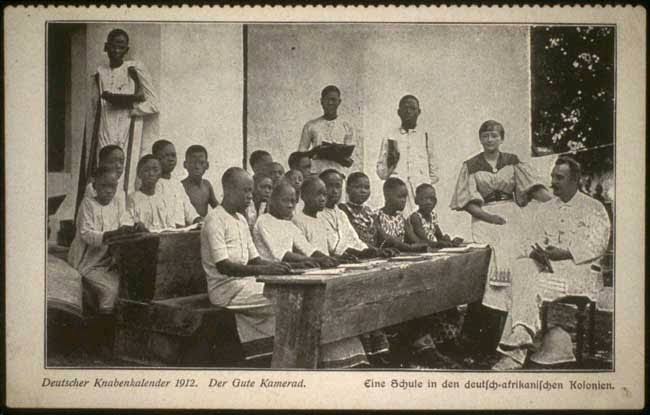
The establishment of a proper system of education begins with the period of British rule at the Cape. This period was marked by a systematic attempt on the part of the British to anglicise Cape society. The period beginning with the occupation of the Cape by the British in 1795 ushers in important social, political and economic developments. The slave trade was abolished in Britain in 1807 and slavery was formally abolished in all colonies of the British empire, including the colony at the Cape, in 1833. The period is marked by the emergence of colonialism proper.
The Schools played a very Signigicant and influential role in this experience. In 1839 an Education Department was established at the Cape with a superintendent, James Rose Innes, at its head. This position was bureaucratised with an administrative apparatus by the end of the century. In Natal, after annexation in 1843, attempts were made to develop an education structure. These only stabilised in 1858. Meanwhile, constitutional provision was made for education in the Transvaal Republic in 1858 and properly so in 1863 in the Orange Free State. Important about this period is that it marks the institutionalization of education in the country and its formal deployment in the cause of building a white identity. One might refer to this period as a period of state-building on the part of the white establishment. The great apparatuses of power were introduced, such as the formal parliaments, the institutions of the military, the hospital services, and alongside these, the institution of the Anglican Church. Yet, at the same time, during this period there is evidence of black and white children being educated in common classrooms. The oldest schools in the country, such as the South African College School (SACS) founded in 1829, for example, has children of different colours. As the process of Anglicisation happens, it happens with some ambiguity.
Alongside of this process of formalisation, another key experience takes root. Significant steps continue to be taken by the rapidly growing missionary movement to provide education for both black and white children. This story begins with the arrival of the London Missionary Society in 1799 and takes shape in the work of people like Dr Phillip and the subsequent establishment of important institutions such as Lovedale College. Emerging clearly out of this development, of course, are the abiding themes of conflict. These conflicts are expressed on several levels and persist in the missionary movement itself, in its target community, the African and slave people, and between the missionaries and the latter, into the climactic era of full modernity in the middle of the 20th century. The begining of colonization and the beginning of education in South Africa can definitely not be utterly separated, as the experiences are interwoven.
The men of Egypt were usually clean shaven and sported both long and short hair styles. Men wore their hair long while boys had their heads shaved except for a lock of hair above their ear. A male body from a working class cemetery in Hierakonpolis dated around 3500 B.C. had a well trimmed beard. Ancient Egyptians sported curls, braids, waves, twists, wigs and extentions, They dyed their hair and cut it short like U.S. Marines.
Women sometimes wore long things in their hair. A female body from a working class grave dated around 3500 B.C. had evidence of hair coloring (henna was used to color grey hair) and hair weaving (locks of human hair were tied to natural objects to produce an elaborate beehive hairdo). A grave in the worker’s cemetery at Hierakonpolis revealed a woman in her late 40s or early 50s with a Mohawk. Egyptians darkened grey hair with the blood of black animals and added false braids to their own hair. The earliest combs are believed are believed to be fish bones. The earliest man-made combs were discovered in 6000-year-old Egyptian tombs. Some had single rows of teeth. Some had double rows of teeth.
Chopped lettuce and ground-up hedgehog spines were applied to the scalp as a remedy for baldness because baldness was not appreciated. Other cultures have tried everything from camel dung to bear grease to achieve the same result. A male body from a working class cemetery in Hierakonpolis dated around 3500 B.C. had a sheepskin toupee used to hide a bald spot.
Scholars often use hairstyles to date objects and even use them to determine foreign influences. There is evidence of influence from other cultures on the Egyptian hairstyles. One example is the cultural union of the Roman Empire and the Egyptian empire. There is evidence of a female mummy wearing a typically Roman hairstyle yet the iconography on her death mask was plainly Egyptian. At Tell el-Daba in Egypt, there was a statue portrayed wearing a mushroom hairstyle that was typical of Asiatic males. There is a statue of young woman in the Ptolemaic period (304–30 B.C.) exhibiting a typical Nubian hairstyle consisting of five small clumps of hair.
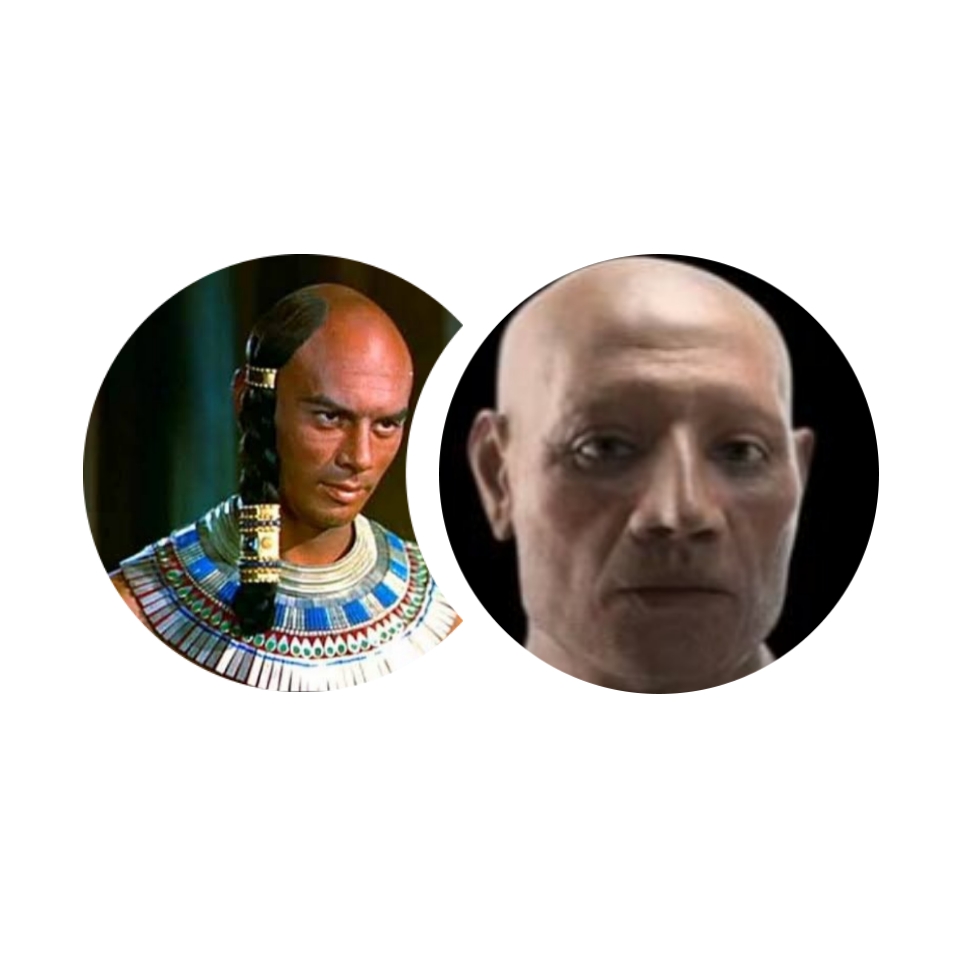
Egyptian men were generally clean-shaven and priests like the one above often shaved their heads. The Egyptians thought that an abundance of facial hair was a sign of uncleanliness and personal neglect. An exception to this was a man’s thin mustache or goatee. There was no soap so an oil or salve was probably used to soften the skin and hairs of the area to be shaved. Tweezers with blunt or sharp ends were used for removing individual facial hairs. Men and women used to shave their heads bald replacing their natural hair with wigs. Egyptian women did not walk around showing their bald heads, they always wore the wigs. Head shaving had a number of benefits. First, removing their hair made it much more comfortable in the hot Egyptian climate. Second, it was easy to maintain a high degree of cleanliness avoiding danger of lice infestation. In addition, people wore wigs when their natural hair was gone due to old age. However, even though the Egyptians shaved their heads, they did not think the bald look was preferable to having hair. Even Priests were required to keep their entire bodies cleanly shaved. They shaved every third day because they needed to avoid the danger of lice or any other uncleanness to conduct rituals. This is the reason why priests are illustrated bald-headed with no eyebrows or lashes.
Hairstyles and Identity As for the Egyptians of ths ancient times, hair styles were often express identity, religious position and class. Style and class were just as important after death. For ancient Egyptians, appearance was an important issue. Appearance indicated a person’s status, role in a society or political significance. Egyptian hairstyles and the common hairstyles of today have many things in common. Like modern hairstyles, Egyptian hairstyles varied with age, gender and social status. Children had unique hairstyles in ancient Egypt. Their hair was shaved off or cut short except for a long lock of hair left on the side of the head (side-lock of youth). This s-shaped lock was depicted by the hieroglyphic symbol of a child or youth. Both girls and boys wore this style until the onset of puberty. Young boys often shaved their heads, while young girls wore their hair in plaits or sometimes did up their hair in a ponytail style, hanging down the center of the back. Young girl dancers used to wear long thick braided ponytails. The edge of the tail was either naturally curled or was enhanced to do so. If the ponytail was not curled at the end, it was weighted down by adornments or metal discs.
The hairstyle of an ancient Egyptian youth
Egyptian men typically wore their hair short, leaving their ears visible. Men often kept these hairstyles until their hair began to thin with advancing age. Another hairstyle for men was distinctive short curls covering the ears shaping a bend from temple to nape. It is doubtful that this hairstyle was natural. It was more likely a result of a process of hair curling that was done occasionally. More unique were the women’s hairstyles than those of men. Women generally preferred a smooth, close coiffure, a natural wave and long curl. Women in the Old Kingdom preferred to have short cuts or chin length bobs. However, women in the New Kingdom (around 1550–1070 B.C.) wore their hair long or touted a wig. Women tied and decorated their hair with flowers and linen ribbons. A stylized lotus blossom was the preferred adornment for the head. This developed into using coronets and diadems. Diadems made of gold, turquoise, garnet, and malachite beads were discovered on an ancient Egyptian body dating to 3200 B.C.
Poorer people used more simple and inexpensive ornaments of petals and berries to hold their hair at the back. Children decorated their hair with amulets of small fish, presumably to protect from the dangers of the Nile. Children sometimes used hair-rings or clasps. Egyptians also wore headbands around their heads or held their hair in place with ivory and metal hairpins. Beads might be used to attach wigs or hair extensions in place. Slaves and servants were not able to dress the same as Egyptian nobility. The way that they adorned their hair was quite different. Commonly, they tied their hair at the back of the head into a kind of loop. They can also tie it in eight or nine long plaits at the back of the head and to dangled them together at one side of the neck and face. So, just by specific hair tie, shape, cut and decoration with different ornaments, age, gender and status are clearly identified. Interesting!
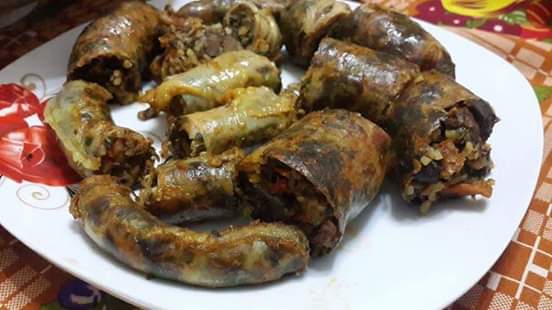
Traditional food in Libya had been structured by its history. This is obvious in the indigenous population “Tamazight”, the different rulers, travelers and neighbors, which all had their great influence; the geographical diversity also had its role in enriching the culture and tradition of Libyan food. Food could talk history, cost differences of traditional Libyan food tells the regular change in history and its effect on people’s life. Generally, Libyan culinary art can be split into three categories: the coastline, which approaches the Mediterranean culture, the south represents the desert culture, in addition to the mountain region, which offer their own blend of mountainous nature, despite this diversity, all regions share the common rules of preparation, and the catering acts. Interesting and amazing!
Food in Libya means more than just eating, it is a way of socializing, and it has its role in social events and religious festivals, by getting together with family, relatives and friends. Libyan dishes as North Africa’s region are often coloured and flavoured with a hot spice mixture. One of the most characteristic dishes of the region is couscous, bearing in mind that each country offers its own blend. Couscous can be found in almost every kitchen cupboard in a Libyan home. Despite the fact that couscous is incredibly popular in Libya, and some consider it as the national dish of the country, the closed door policy imposed by the former regime, including lack of participation in international festivals to introduce their heritage in all its forms, made couscous usually attributed to neighboring countries without pointing to Libya.
Couscous
Couscous is a steamed small-grained semolina, served with stew. It is one of the top dishes served in weddings and big occasions. The dish is ancient, mentioned by the medieval traveler Ibn-Battuta. It was even passed to Mediterranean territories like Spanish and Italian cuisine, and some parts of Spain still share the tradition of having couscous as a main dish at weekends.
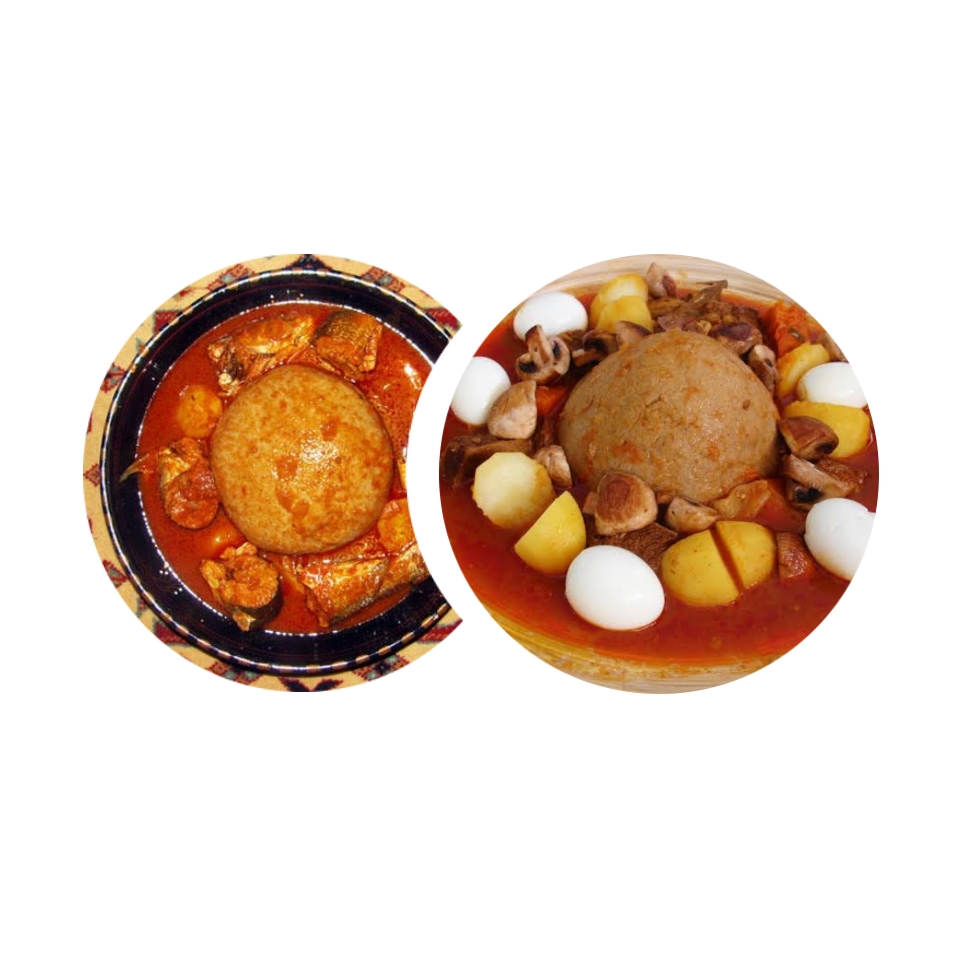
Bazin is among the most distinctive foods of Libyan culinart arts. Bazin is identified by its special pyramid shape. It is prepared by boiling the barley flour in water until it ripens and then it is molded into a pyramid shape. It could be served with a wide variety of stews including meat stew, bean and legume sauce, sour milk besides other kind of stews. This dish expresses the Libyan lifestyle of eating healthfully. It is usually presented in special occasions. The Italian culinary arts has its touch on Libyan dishes. The most popular and widely spread is Pasta presented in different ways. One of Libyan’s favorite is Rishda, a homemade pasta cooked with dried salted meat, legume and herbs.
BazinRishda
Usban is another top Libyan dish. Indisputably, it is the must-have meal. It is usually served in Eid and special occasions. Simplicity along with coloured and unique flavour makes any traditional Libyan dish worth trying. Sfinz is a traditional Libyan fried pastry made with a dough consisting of flour, sugar, yeast, salt, and water. The dough is shaped into small balls which are then flattened to form a thin layer of pastry. After it has been fried, sfinz is typically enjoyed with honey. Yet, it can also be fried with an egg on top. Also available is the Libyan doughnut, this fried pastry is especially popular for breaking the fast during Ramadan, but it can also be served for breakfast. If there is any leftover dough, Libyans usually transform it into herb bread.
UsbanSfinz
Salata mashwiya (this means roasted salad, and it is known by that name in both Libya and Tunisia, where salata mashwiya is also quite popular) is a spicy Libyan dish that can be served either as a salad or a hot sauce accompanying barbecued meat and freshly baked bread. It consists of tomatoes, bell peppers, onions, eggplants, hot chiles, and garlic. The salad is typically flavored with ground caraway seeds and garnished with olives and hard-boiled eggs. Tajin mahshi is a flavourful Lybian dish that is typically served as a main meal or a side dish. It consists of a variety of stuffed vegetables such as bell peppers, tomatoes, aubergines, and courgettes. The filling is usually prepared with a combination of ground meat, onions, rice, and spices such as chiles, salt, pepper, turmeric, ginger, and cinnamon. It is said that tajin mahshi tastes even better when reheated the next day.
Salata mashwiya
Originating from East Libya, makaruna imbaukha is a savory dish made with steamed pasta as the key ingredient. The pasta is combined with meat (usually lamb) and a rich sauce made with clarified butter, tomatoes, onions, chickpeas, potatoes, pumpkin, and raisins. The whole dish is typically flavored with cloves, bay leaves, ginger, black pepper, and shaiba leaves. For the final touch, makaruna imbaukha can be sprinkled with orange flower water and cinnamon. When served, the pasta is traditionally spread in the center of the plate and topped with everything else. It is recommended to serve the dish with Libyan pickles known as mseyer on the side.
Makaruna imbaukha of East Libya (with Pupkin and Raisin)
Ruz hoot bil kusbur is an aromatic Libyan dish consisting of rice cooked in a stock made from fish heads. It is combined with oil, roasted coriander seeds, onions, tomatoes, celery, and flavorings such as parsley, chile peppers, garlic, ginger, cumin, paprika, and black pepper. The dish is traditionally served with grilled, baked, or fried white fish fillets which were previously marinated in a combination of garlic, cumin, hot peppers, and lemon juice. It is recommended to further elevate the dish by serving it with haraymi sauce and lemon wedges on the side. Trying any of these dishes is worth it. You can just dare to have a taste different from the ones you’ve being used to.
Change constitutes an important part of human living, that if man does not embrace in the right way, man will deny himself the necessary beauty of life.
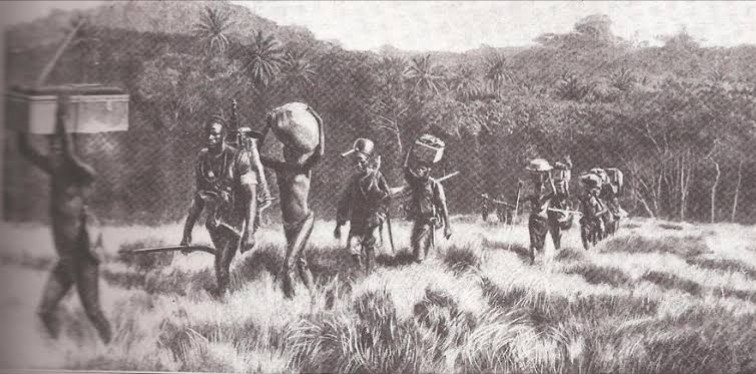
Historians believe that the original inhabitants of Côte d’Ivoire were all either displaced or absorbed by the ancestors of the present inhabitants, because little is known about their origin. The first recorded history is found in the chronicles of North African Muslim traders, who, from early Roman times, conducted a caravan trade across the Sahara in salt, slaves, gold, and other items. The southern terminals of the trans-Saharan trade routes were located on the edge of the desert, and from there supplemental trade extended as far south as the edge of the rain forest.
Djenné, Gao, and Timbuctu are the more important terminals that grew into major commercial centers around which the great Sudanic empires developed. By controlling the trade routes with their powerful military forces, these empires were able to dominate neighboring states. The Sudanic empires also became centers of Islamic learning. Islam had been introduced into the western Sudan by Arab traders from North Africa and spread rapidly after the conversion of many important rulers. From the eleventh century, by this time the rulers of the Sudanic empires had embraced Islam, it spread south into the northern areas of contemporary Ivory Coast.
Ghana, the earliest of the Sudanic empires, flourished in present-day eastern Mauritania from the fourth to the thirteenth century. At the peak of its power in the eleventh century, its realms extended from the Atlantic Ocean to Timbuctu. After the decline of Ghana, the Mali Empire grew into a powerful Muslim state, which reached its apogee in the early part of the fourteenth century. The territory of the Mali Empire in Ivory Coast was limited to the northwest corner around Odienné. Its slow decline starting at the end of the fourteenth century followed internal discord and revolts by vassal states, one of which, Songhai, flourished as an empire between the fourteenth and sixteenth centuries.
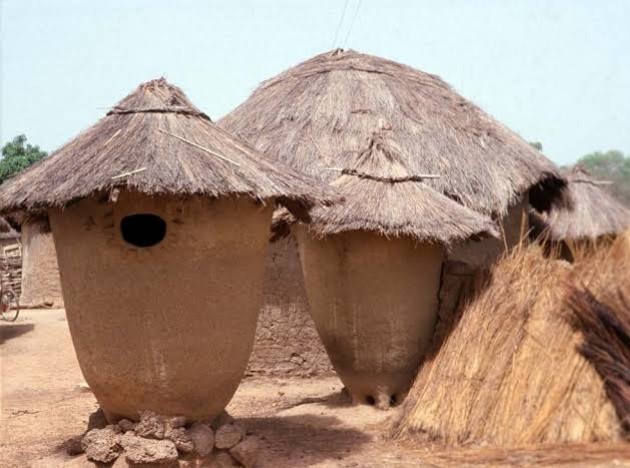
Notwithstanding, Songhai was also weakened by internal discord, which led to factional warfare. This discord spurred most of the migrations of peoples southward toward the forest belt. The dense rain forest covering the southern half of the country created barriers to large-scale political organizations as seen further north. Some inhabitants lived in villages or clusters of villages whose contacts with the outside world were filtered through long-distance traders. By the virtue of this, there is not only commercial interaction their cultures also interact. Villagers subsisted on agriculture and hunting.
In the pre-European era there were five important states that flourished in Ivory Coast. The Muslim Kong Empire was established by the Juula in the early eighteenth century in the north-central region inhabited by the Sénoufo, who had fled Islamization under the Mali Empire. Although Kong became a prosperous center of agriculture, trade, and crafts, ethnic diversity and religious discord gradually weakened the kingdom. The city of Kong was destroyed in 1895 by Samori Touré. The Abron kingdom of Jaman was established in the seventeenth century by an Akan group, the Abron, who had fled the developing Asante confederation in what is present-day Ghana.
The Abron gradually extended their hegemony over the Juula in Bondoukou, from their settlement on the south of Bondoukou. These were recent émigrés from the market city of Begho. Bondoukou developed into a major center of commerce and Islam. The kingdom’s Quranic scholars attracted students from all parts of West Africa. In the mid-eighteenth century in east-central Ivory Coast, other Akan groups fleeing the Asante established a Baoulé kingdom at Sakasso and two Agni kingdoms, Indénié and Sanwi. The Baoulé, like the Asante, elaborated a highly centralized political and administrative structure under three successive rulers, but it finally split into smaller chiefdoms.
Despite the breakup of their kingdom, the Baoulé strongly resisted French subjugation. The descendants of the rulers of the Agni kingdoms tried to retain their separate identity long after Ivory Coast’s independence; as late as 1969, the Sanwi of Krinjabo attempted to break away from Ivory Coast and form an independent kingdom. The living and existence of man is subject to change from time to time. Change constitutes a important part of human living that if man does not embrace in the right way, man will deny himself the necessary beauty of life. Even though, change from external communities are not welcomed, internal change will not always be defeated.
A cataract is a clouding of the eye’s natural lens. It is the most common cause of blindness in people over the age of 40. It affects more than 20 million …
A cataract is a clouding of the eye’s natural lens. It is the most common cause of blindness in people over the age of 40. It affects more than 20 million people globally with over 51% of them in developing countries like Nigeria. It is speculated that over 600,000 Nigerians may have cataracts.
IT IS CURABLE!
The lens is a clear part of the eye behind your iris that helps to focus light or an image on the retina, which helps us to see via a complex mechanism.
The lens must be clear for the retina to receive a sharp image. If the lens is cloudy from a cataract, the image will appear blurry, cloudy, misty or faded.
Types of cataracts
Cataracts develop slowly and can be found in one or both eyes. It cannot spread from one eye to the other. There are three types of cataracts: • A subcapsular cataract occurs at the back of the lens. It is common in diabetics. • A nuclear cataract forms in the central area of the lens. • A cortical cataract starts in the periphery of the lens and works its way to the centre in a spoke-like fashion.
What causes cataracts?
Ageing is the commonest cause of cataracts. Yet, certain things make it more likely that a person will develop cataracts. • Secondary cataract can form after surgery for other eye problems like glaucoma. • Cataracts can also develop in people who have other health problems like diabetes. • Cataracts are sometimes linked to steroid use. • Cataracts can develop after an eye injury, sometimes years later. • Some babies are born with cataracts or develop them in childhood, often in both eyes. These are usually due to maternal infections. • Cataracts can develop after exposure to some types of radiation.
Symptoms
• Your sight is misty and cloudy. You may feel like your glasses are dirty and need cleaning, even when they don’t. • Colours seem faded or look a little more washed out than they should be. • Double vision. • Frequent prescription changes. •Sensitivity to light and glare – headlights, lamps or sunlight may seem too bright. You may also see a halo around lights. • Night blindness.
How can one prevent the development of cataracts?
Besides elderliness, there are risk factors for cataracts. They can be managed to reduce the onset and severity of symptoms as well as the progression of cataract. These steps include: • Control your blood sugar and blood pressure if you are diabetic and/or hypertensive. • Wear appropriate eye wears to shield the eyes from ultraviolet radiation from sunlight and other sources. • Keep fit and maintain a healthy weight. • Quit smoking. • Use steroid-containing medications only on doctor’s orders. • Protect your eyes from trauma during sports and avoid violence. • Reduce your alcohol consumption. • Eat more fruits and vegetables.
Cataract treatment.
The definitive treatment for cataracts is surgery where the affected lens is removed and replaced with the an artificial lens that does the same thing. The procedure is very safe and patients regain near perfect vision after the procedure.
N.B: If you think you have a cataract, see an eye doctor for an exam to find out for sure.
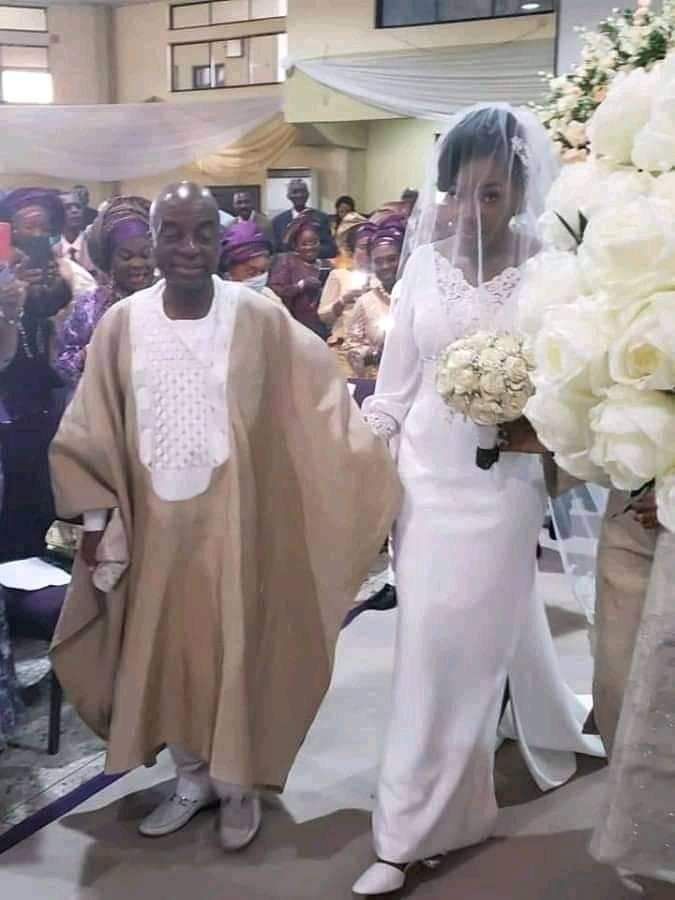
It was a very glorious sight to behold Joys Oyedepo and Abodunrin Olaleye come together in Holy matrimony today! God bless the latest couple in the world. Amen
It was a very glorious sight to behold Joys Oyedepo and Abodunrin Olaleye come together in Holy matrimony today! God bless the latest couple in the world. Amen
From Africannews we wish you a happy married life.
The Debt Management Office (DMO) has vowed to deal with any of its staff responsible for leaking official documents. According to a statement issued Saturday evening, the DMO said it “will …
The Debt Management Office (DMO) has vowed to deal with any of its staff responsible for leaking official documents.
According to a statement issued Saturday evening, the DMO said it “will brief relevant security agencies in the country to thoroughly investigate the sources of the documents”.
The reason for involving security agencies, the DMO said, is “with a view to bringing the perpetrators to book in line with Public Service Rules No. 030401 and 030402, which prescribes dismissal for unauthorised disclosure of official information as a serious act of misconduct”.
Vanguard newspaper had run a story titled “Alleged N1.08bn corruption scandal hits DMO”. Reacting to the story, the DMO said “the sponsors of the story are disgruntled elements who have not only breached the Civil Service Rules but have also contravened laid down procedures for dealing with official matters”.
It went on to state that “these officials have resorted to illegally leaking official documents due to their recent redeployment; have colluded with other disgruntled persons who have failed in their attempts to control the running of the affairs of the DMO, which has blocked their ability to pilfer public funds”.
The DMO added that “the story referred to documents that, on their own, are incomplete and do not reflect the whole story or the purpose of any transaction”.
DMO denied claims that events and travels by officials of the DMO either did not take place or did not hold as “false and an attempt to discredit the impeccable records of the organisation. These speak to their desperation to give the institution a bad name”.
The nation’s debt managers described itself as “an accountable, transparent and responsible organisation that works in accordance with laid down civil service procedures”.
It noted that “it is highly regarded by multilateral agencies and financial institutions as a reputable goverment, the DMO lamented, has “been twisted and distorted with the intention to misinform the general public and discredit the institution.
Counsel for the late Senator Buruji Kashamu, Mr Ajibola Oluyede, said his client, before his death, withdrew the lawsuit filed against rival lotto operators in the country, including Sir Keshington Adebutu’s …
Counsel for the late Senator Buruji Kashamu, Mr Ajibola Oluyede, said his client, before his death, withdrew the lawsuit filed against rival lotto operators in the country, including Sir Keshington Adebutu’s Premier Lotto, popularly known as Baba Ijebu.
Sir Adebutu Receiving Late Kashamu’s call on His seek bed.
Oluyede told newsmen on the telephone on Thursday that Kashamu, through his firm, Western Lotto Limited, took the decision prior to his death on August 8.
The lawyer was contacted against the backdrop of a viral video suggesting that the late Kashamu, while on his sickbed, placed a phone call to Adebutu to seek his forgiveness and pledged to drop legal actions against Premier Lotto.
In the video, Adebutu had demanded that Kashamu withdraw the court case against him in demonstration of his penitence.
The two businessmen from Ogun State were embroiled in a legal tussle in relation to the proprietary right over ‘Ghana games’.
In a suit filed before the Federal High Court in Lagos, Kashamu’s Western Lotto accused Adebutu’s Premier Lotto and 22 other rival lotto firms of infringing on its trademark.
The court last year December granted Western Lotto an anton piller order to enter into and search the offices of the rival lotto firms for evidence of the alleged infringement on its licence on ‘Ghana games’.
Justice C.J. Aneke also dismissed the defendants’ preliminary objection, challenging the court’s jurisdiction and seeking to set aside the antom piller order.
The defendants went on appeal.
Oluyede told our correspondent on Thursday that the matter was withdrawn before Kashamu died.
He said, “There is only one action that involves Adebutu’s company; it involves all the operators as well as the lottery regulatory commission. That action was at the Federal High Court; and before Senator Kashamu departed we had discontinued the action against all the operators, including Sir Keshington’s Premier Lotto. So, there is actually, as of today, no real pending action against them.”
On the appeal filed by the defendants, Oluyede said, “The discontinuance of the case brings an end to everything. That one is now left for the Court of Appeal to decide whether they still want to continue with the appeal or the appeal is now an academic exercise. Our own position is that the appeal is now an academic exercise.”
In the video, Adebutu was seen receiving a call from Kashamu, with his mobile phone on speaker while he was being video-recorded.
In the conversation, which was majorly in Yoruba language, Kashamu profusely begged Adebutu to forgive him, saying he was ready to do as Adebutu pleased, including supporting his son, Ladi, to become the Ogun State Governor.
Meanwhile, an associate of Adebutu, Aare Kola Oyefeso, said the video was released to the public in good faith.
Oyefeso, a close ally of the billionaire businessman, confirmed that the video emanated from the Adebutu family to show the world that the duo had reconciled.
He said, “I am confirming to you on my word of honour before God and man that the video is authentic.
“It was Kashamu speaking to Sir Adebutu, not Baba speaking to Kashamu.
“On his sickbed, he realised his shortcoming and he tried to makeup and he indeed made up.”
Workers of Adama Beverages Limited, Atiku’s company have faulted the concocted report on the mass sack, molestation of a female worker. The union of Food, Beverages, and Tobacco Senior Staff Association …
Workers of Adama Beverages Limited, Atiku’s company have faulted the concocted report on the mass sack, molestation of a female worker.
Atiku Abubakar
The union of Food, Beverages, and Tobacco Senior Staff Association (FOBTOB), of Adama beverages Ltd, producers of Faro bottle water and Faro juice, in Adamawa State has denied reported massive sack of staff and maltreatment of a female worker and other sundry allegations as reported in one of the national dailies.
This was contained in a statement co-signed by the chairman of the union Mr Palke J. Bwalbumo and his secretary Mr Danjuma K Audu faulted the said news item in its entirety saying it is libellous aimed at tarnishing the good image of the company.
The statement also stated that the report was also aimed at tarnishing the good image of the former Vice President Atiku Abubakar who is the sole owner of the company.
“Concerning the report in a section of the media alleging that the management of Adama beverages Ltd producers of the popular Faro table water and beverages engaged in unethical conducts inimical to industrial labour relations, we wish to state that the story in its entirety is fabricated lies aimed at tarnishing the image of our company and its management led by Mr Francis Vazheparambil.
”Taking into cognizance that the so-called “spokesman” of the company’s union referenced in the story, Abdullahi Maigida Bello is not an employee of the company, we are compelled as a responsible union to set the records straight.
“For the avoidance of doubt, there has never been any case of molestation of any female worker or anyone in the entire workforce.
”Despite deep economic turmoil caused by the COVID-19 pandemic, there has not been any mass sack in Adama beverages and no staff is owed salaries as all wages are paid promptly.
“The union rejects the claim that there was a blockage of roads and vehicle movement within the precinct of the factory as reported.
”The union called for the withdrawal of all fallacious publication against our COO, Mr Francis Vazheparambil, whose sterling leadership has impacted positively on the company.
“The union also called for the withdrawal of all false newspaper report against the organisation as a whole. We are proud of the organisation and also the management.
”The malicious and deliberate allegation against Mr Francis Vazheparambil cannot be swept under the carpet and we demand that the story should be retracted and apologies being made to the company and its management. Failure to do so shall be met with immediate legal action,” the statement reads.
We use cookies on our website to give you the most relevant experience by remembering your preferences and repeat visits. By clicking “Accept”, you consent to the use of ALL the cookies.
This website uses cookies to improve your experience while you navigate through the website. Out of these, the cookies that are categorized as necessary are stored on your browser as they are essential for the working of basic functionalities of the website. We also use third-party cookies that help us analyze and understand how you use this website. These cookies will be stored in your browser only with your consent. You also have the option to opt-out of these cookies. But opting out of some of these cookies may affect your browsing experience.
Necessary cookies are absolutely essential for the website to function properly. This category only includes cookies that ensures basic functionalities and security features of the website. These cookies do not store any personal information.
Any cookies that may not be particularly necessary for the website to function and is used specifically to collect user personal data via analytics, ads, other embedded contents are termed as non-necessary cookies. It is mandatory to procure user consent prior to running these cookies on your website.