Over 150 hectares of sugarcane fields have been destroyed in Cameroon due to violent clashes between workers at the Société Sucrière du Cameroun (SOSUCAM) and police. The unrest, which erupted earlier …
FIFA has announced the immediate suspension of the Congolese Football Federation (FECOFOOT), following escalating tensions between the Ministry of Sports and the football body. The dispute, which has been ongoing for …
A federal judge has delivered a major blow to President Donald Trump and his ally, billionaire Elon Musk, halting plans to pull thousands of staffers from the U.S. Agency for International …
Namibia is one of the gems in Africa’s crown and often omitted for its lush neighbour Botswana when it comes to safari holidays.But this magnificent southern African has so a good deal to offer in its very own right from impressive landscapes and numerous wildlife to
Namibia is one of the gems in Africa’s crown and often omitted for its lush neighbour Botswana when it comes to safari holidays.But this magnificent southern African has so a good deal to offer in its very own right from impressive landscapes and numerous wildlife to friendly, welcoming people. It be high on the bucket list of places to visit when the world opens up again.
Ethereal landscapes
One of Namibia’s most superb points of interest is the Sossusvlei. Situated in the biggest conservation location in Africa (the Namib-Naukluft National Park), Sossusvlei is a widespread salt pan of dry, cracked earth dotted with ghostly trunks dead bushes and surrounded by using towering red sand dunes.
Sossusvlei translates to “dead-end marsh”, and is recognised by neighborhood bushmen as the location where the dunes come collectively and forestall the Tsauchab River from flowing any further. In specially wet seasons, the river breaks its banks and fills the otherwise-empty pans, reworking the arid wasteland into a vivid blue-green lake that attracts a wealth of natural world and birds.
Giant elephants jostle with lanky ostriches whilst they revel in the watery pans, and huge herds of oryx meet head-to-head with hordes of desert zebra, developing unforgettable flora and fauna scenes that are not often viewed in this region.
The historical star-shaped dunes with their prism of colours, steep sandy slopes, and razor-sharp peaks stand sentry over the landscape, while the stark white flooring of the salt clay pans stretch for as a ways as the eye can see. This offers a visible treat to the eyes as properly as the camera lens, and tourists and photographers alike flock to the region to trip the amazing beauty.
The profound beauty of the dunes stems from the sand itself. The newer sand is flecked with darker colorings of red and tinges of orange, while the extra historic particles appear red or from time to time tremendous mauve. This myriad of colorations makes the dunes seem to be exclusive from daybreak to midday and from noon to dusk. This herbal patterning paired with the daylight taking part in on the dunes is in reality out of this world and worth journeying Namibia just to see them.
Float above Namibia’s beauty
One of the first-class methods to ride the Sossusvlei is on a hot-air balloon adventure over the wasteland and the dunes. Several agencies offer guided ballooning trips over Namibia’s spectacular landscapes, many of which generally commence before dawn, allowing friends to watch the solar upward thrust over the undulating crimson and scarlet sand dunes.A warm air balloon day out also provides the unique danger to see the enigmatic fairy circles — an exciting phenomenon of the Namib Desert which are shaped from indented circular patches devoid of vegetation.
The best way to explore the Sossusvlei is by means of car. The roads are appropriate – you won’t need a 4×4 car unless you are planning to head off the overwhelmed music — the signboards are handy to apprehend and navigation to any destination is simple.So, start planning a one-of-a-kind street outing to “The Land of Many Faces” and ride one of the most stunning international locations in Africa
Most economists see structural transformation as one of the major routes to Africa’s sustainable development…African leaders have their work reduce out to make the continental free trade area a success.
Most economists see structural transformation as one of the major routes to Africa’s sustainable development…African leaders have their work reduce out to make the continental free trade area a success. Wikimedia Commons.With this purpose in mind, economists and policymakers need to comprehend what determines structural transformation. They have flagged factors like demand for goods and services, exchange policies, economic development, institutional first-class and monetary integration.But researchers haven’t intently examined the way economic integration via alternate and finance influences structural transformation.
I, therefore, set out to study African countries’ integration with the rest of the world and the impact of that integration on their structural transformation. This study provides clean proof about whether or not integration is good for Africa. It additionally reveals the right degrees of integration fundamental to increase structural transformation.Trade and monetary integration are both about countries exporting to and importing from each other. The two are often referred to as financial integration. Opening countrywide borders to change has a quantity of possible advantages which can promote development. For example it creates comparative advantage, get admission to external finance and possibilities for risk sharing. It also enables technology transfer. Local corporations serving larger overseas and home companies can acquire expertise and capabilities and switch them to the rest of the economy.
All these benefits are imperative for structural transformation. But immoderate openness and integration may additionally additionally come at a cost, mostly from distortions around trade policy. For instance, if positive neighborhood industries have been protected, local firms might also no longer be suit adequate to compete with overseas counterparts. Opening these industries to competition can also damage them.Balancing the workable benefits and dangers of integration is a pressing policy trouble now that African countries have signed the African Continental Free Trade Area agreement, which goals to foster integration.Policymakers want to recognize whether or not there is an ideal level of trade and financial integration that will alternate economies in the preferred ways.
The study: findings and implications
With this background, I examined the results of economic integration on structural transformation in 32 African international locations from 1985 to 2015. The time length and choice of international locations were primarily based on data availability.
I created an index of structural transformation that comprises changes in sectoral value addition and demographic characteristics. The index degrees between 0 (low transformation) and 1 (high transformation). I found that structural transformation on the continent was once low, with an average fee of 0.419, but different throughout countries.The majority of the countries’ indices had been lower, suggesting that structural transformation is solely just beginning.I additionally observed that African nations were less integrated in phrases of alternate and finance than different developing economies.
I measured change integration as the ratio of countries’ imports and exports to GDP. This indicates the degree of openness. I determined that the superior level for alternate integration was 73.29% of GDP. By this I suggest the stage of trade integration that produces an accelerated impact on structural transformation.The facts counseled that change integration encourages the reallocation of assets to extra productive sectors.To measure monetary integration, I used the ratio of countries’ whole foreign liabilities and property to GDP. This suggests the diploma of restrict of capital flows. The superior stage for economic integration was 137.5% of GDP. Ten African countries have been above these stages and 22 have been below.The 10 countries that are above this financial integration threshold are Botswana, Congo Republic, Côte d’Ivoire, The Gambia, Guinea Bissau, Mauritania, Mauritius, Seychelles, Sudan and Togo. Similarly, the 10 countries above the alternate integration threshold are Botswana, Congo Republic, Côte d’Ivoire, Gabon, Mauritania, Mauritius, Seychelles, Eswatini (formerly Swaziland), Togo and Tunisia.
I determined that structural transformation will increase more in international locations that are under these levels of integration in contrast to nations that are above the thresholds. Integration increases structural transformation, but too much integration slows that process, producing undesired effects.The fantastic effect of integration on transformation takes place via improved efficiency, comparative advantage, exterior finance and risk diversification. Countries can have these elements notwithstanding being less integrated and operating beneath the thresholds. The advantages of integration come from effectivity of integration alternatively than unbridled integration.A key implication is that effectivity in each trade and monetary integration is vital to using structural transformation in Africa. This explains the urgent need for African nations to concurrently deepen trade and financial integration. Economies that embark on monetary integration alongside both strains can count on to have expanded transformation for sustainable development.
The function of the free trade area
The learn about suggests that Africa has possibilities to integrate further. The African free exchange place has the doable to defragment the continent and deliver its economies into the international economy.The free alternate place ambitions to gradually cast off tariffs and non-tariff boundaries to exchange in goods and to liberalise change in services. It will establish a single continental market for items and services: a better and extra aggressive market.A higher free trade place will now not solely boost intra-regional trade, it will also hasten the development of regional supply chains. These have pushed structural transformation in other regions, for example Asia. It is additionally necessary for coverage to address the non-tariff limitations to trade. Among these are bad logistics and infrastructure (such as roads, rail, ports, power and digital connectivity).Countries be focusing on getting rid of such bottlenecks. The African Union, United Nations Economic Commission for Africa and the African Development Bank need to get the free exchange region working as soon as possible.
The various culinary arts of Africa use a combination of locally available fruits such as cereal grains and vegetables, as well as milk and meat products in the traditional way. In some parts of the African continent, the traditional diet features an abundance of milk, curd and whey products. Central Africa, East Africa, North Africa, Southern Africa and West Africa each have distinctive dishes, preparation techniques, and consumption methods. Indeed! A lot of African dishes are well spiced and properly garnished; not just for a mouth watering aroma and inviting presentation but also for a healthy and delicious meal. Africans don’t just eat; Africans eat healthy.
Central Africa stretches from the Tibesti Mountains in the north to the vast rainforest basin of the Congo River, the highlands of Kivu and the savana of Katanga. This region has received culinary influence of the Swahilis (a culture that evolved via the combination of Bantu, Yemeni, Omani and Indian cultures) during the East African Slave Trade. The influences of Swahili culinary can be found in dishes such as: mandanzi, pilaf rice, kachumbari, sambsusa , kuku paka, etc.
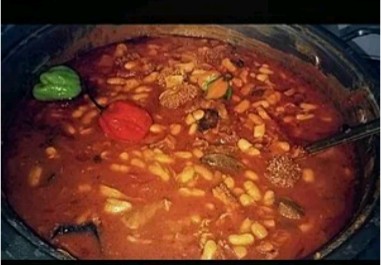
Madesu Beans is an essential supply
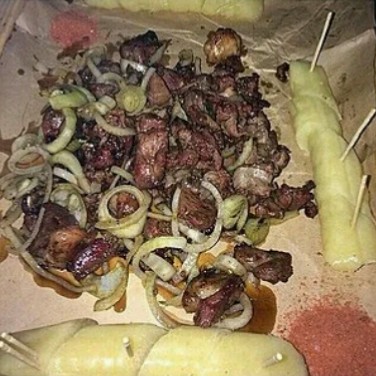
Central African culinary art has also been influenced by the Portuguese, by way of the Kongo and Ndongo Kingdoms. Salt fish was introduced following trade in the late XVIIth and the Kikongo term for salt fish, makayabu, comes from the term bacalhau (ba-cal-ha-u). The Portuguese culinary influence is especially prominent in Angola, Sao Tomé and Equatorial Guinea. Central Africa has also been influenced by the culinary art of the regions East, West and Southern Africa because of their close proximity. i.e: Babuté/ Bobotie is shared with the south, nyama choma with the east and gombos with West Africa. The Ntaba Central African-style lamb barbecue: The main ingredients are plantains, cassava, rice, kwanga (cassava dumpling) and yam .The “Fufu -like” starchy foods (some of these food types include some of the so called “swallow or solid foods” and “pap-like or custard-like” foods) are usually made from fermented cassava roots, but they can also be made with plantain, corn maize and yam. Fufu is served buffet style with grilled meat, fish, stews, greens and piment . A variety of local ingredients are used while preparing other dishes like spinach stew cooked with tomato, peppers, chillis, onions, and peanut butter.
Barbecue
Eastern central Africa is also one of the few regions in Africa that uses potatoes as one of its main bases of food, since potatoes grow easily in the region. Cassava plants are also consumed as cooked greens. Groundnut also known as peanut stew is also prepared, containing chicken, okra, ginger, and other spices. Another commonly served dish is bambara (a porridge of rice), peanut butter and sugar. Chicken and fish are favorite meat dishes, but game meat preparations containing crocodile, elephant, antelope and warthog are also occasionally served. The culinary art of East Africa varies from a particular geographic region to another geographic region. In the inland savannah, the traditional culinary art of cattle-keeping peoples is distinctive because meat products are generally absent. Cattle, sheep, pigs and goats were regarded as a form of currency and a store of wealth, and are not generally consumed as food.
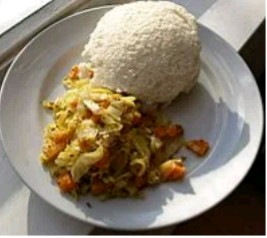
In some areas, traditional East Africans consume the milk and blood of cattle, but rarely the meat. Elsewhere, others are farmers who grow a variety of grains and vegetables. Maize (corn) is the basis of ugali, the local version of West and Central Africa’s “Fufu”. Ugali is a starch dish eaten with meats or stews. In Uganda, steamed green bananas called matoke provide the starch filler of many meals.
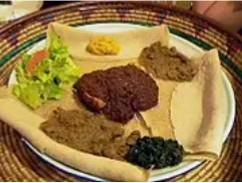
The Omani and Yemeni merchants settled on the Swahili Coast around 1000 years ago. The influences of the Middle East are especially reflected in the Swahili culinary art of the coast – steamed or cooked rice with spices in Persian style; saffron, cloves, cinnamon and several other spices; and pomegranate juice. Several centuries later, the British and the Indians came, and both brought with them foods such as Indian spiced vegetable curries, lentil soups, chapattis and a variety of pickles which have influenced various local dishes. Some common ingredients used in this region include oranges, lemons, limes, chillis, capsicum peppers, maize, tomatoes, and strawberries. In the Horn of Africa (a peninsula of Africa which juts into the Arabian Sea), the main traditional dishes in Eritrean culinary art and Ethiopian culinary art are tsebhis (stews) served with injera (flatbread made from teff, wheat, or sorghum) and hilbet (paste made from legumes, mainly lentils and fava beans). The Eritrean and the Ethiopian culinary arts (especially in the northern half) are very similar, given the shared history of the two countries. Eritrean and Ethiopian food habits varies from region to region. In the highlands, injera is the staple diet and is eaten daily among the Tigrinya. Injera is made out of teff, wheat, barley, sorghum or corn, and resembles a spongy, slightly sour pancake. When eating, diners generally share food from a large tray placed in the center of a low dining table. Numerous injera is layered on this tray and topped with various spicy stews. Diners then break into the section of injera in front of them, tearing off pieces and dipping them into the stews.
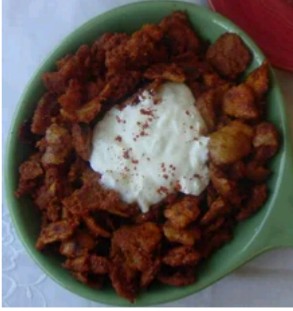
Kitcha fit-fitUgali
Meanwhile, in the lowlands, the main dish is akelet, a porridge-like dish made from wheat flour dough. A ladle is used to scoop out the top, which is filled with berbere and butter sauce and surrounded by milk or yoghurt. A small piece of dough is broken and then used to scoop up the sauce.
Injera (a pancake-like bread) served with several kinds of wat (stew)
The best known Ethio-Eritrean culinary consists of various vegetable or meat side dishes and entrées, usually a wat, or thick stew, served atop injera, a large sourdough flatbread made of teff flour. One does not eat with utensils, but instead uses injera to scoop up the entrées and side dishes. Tihlo, which is prepared from roasted barley flour, is very popular in Amhara, Agame, and Awlaelo (Tigray). Traditional Ethiopian culinary employs no pork or shellfish of any kind, as they are forbidden in the Jewish and Ethiopian Orthodox Christian faiths.Eating from the same dish in the center of the table with a group of people is a common practice. This portrays an example of the relational attitudes of the African people.
The United Bank for Africa Plc (UBA) has announced a $200 million facility support to boost Nigeria’s crude oil production capacity.The facility is part of a $1.5 billion Pre-Export Finance Facility supplied through consortium of Nigerian industrial
The United Bank for Africa Plc (UBA) has announced a $200 million facility support to boost Nigeria’s crude oil production capacity.The facility is part of a $1.5 billion Pre-Export Finance Facility supplied through consortium of Nigerian industrial and global banks, with UBA as the lead arranger, for the Nigerian National Petroleum Corporation (NNPC) and its upstream subsidiary, the Nigerian Petroleum Development Company (NPDC).The financial institution in a announcement, announce the deal said it will provide $200 million to help funding growth and liquidity requirements.
It stated: “The facility will grant a whole lot wished capital for investment in NNPC’s manufacturing capacity, which is of strategic importance to the Nigerian financial system and the country’s leading supply of overseas exchange earnings. UBA’s role as Lead Arranger recognises the Group’s energy in structuring and deploying financing to the oil and gas sector, and the depth and liquidity of the Group’s balance sheet.
“The $1.5 billion facility is structured in two tranches. The first tranche of $1 billion, to be repaid over a period of five years, will be supplied in dollars, with UBA acting as the Facility Agent Bank. The 2nd tranche of $500 million, will be provided in nearby currency, over seven years, with UBA performing as Lead Bank, supplying $200 million in naira equivalent. “Both services will be repaid from an allocation of 30,000 barrels per day of NPDC’s crude oil. UBA has a robust music report in the resources area across Africa, having facilitated oil prepayment deals with the NNPC, including its 2013 $100 million participation in the PXF Funding Limited transaction, and a in addition $60 million in the 2015 Phoenix Export Funding Limited transaction. In Senegal, UBA was once accountable for the EUR 240 million revolving crude oil financing facility for the Société Africaine de Raffinage and in Congo Brazzaville co-funded the $250 million crude oil prepayment facility for Orion Oil Limited. “Other members in the NNPC deal include Standard Chartered Bank, Afrexim Bank, Union Bank and two oil buying and selling companies, Vitol and Matrix.”Speaking on this development, UBA Group Chairman, Tony O. Elumelu cited “This has been one of the most economically challenging years that Nigeria has witnessed. With the sharp drop in the charge of oil and the ensuing hardship that accompanied the onset of the Covid-19 pandemic, the non-public area should come collectively and make a contribution meaningfully to the economy.
The government of Ogun state had rescinded her earlier decision of the N25,000 payment for COVID-19 test by private school boarding students that was initially announced. Recall that academic activities had been interrupted nationwide due to the outbreak of COVID-19 Pandemic. So in preparation for West African Senior School Certificate Examination, Senior Secondary School 3 (SSS 3) students resumed on the 4th of August. The decision was made so that the students will be adequately prepared for the examination, as the exam is fast approaching. The date for the commencement of the exam is 17th August.
The government of Ogun State mandated that the S.S.S 3 students must be tested for COVID-19 and Malaria before they resume. This is the prerequisite for resumption which every returning boarding student must meet up with. Meanwhile, Ronke Soyombo, the Special Assistant to the Governor on Primary and Secondary education, noted that the ministry of health has made provision for a COVID-19 and MALARIA TESTS for all S.S.S 3 returning boarding students in the State; as part of the conditions for the reopening of schools in some Public Health Care facilities between Friday 31st July & Monday 3rd August, 2020. Ogun State General Hospital, Ota, the 250 MTR Okemosan, Abeokuta, and Olabisi Onabanjo University Teaching Hospital, Sagamu are part of the facilities.
She also added that the COVID-19 certificate showing ‘Negative’ is part of the very important conditions for allowing the boarding students into the school. The Principals are directed to disseminate the above important information to all S.S.S 3 students in the State immediately. They are to also ensure that the above instructions are strictly obeyed as any defaulting school will be sanctioned.
On getting to the testing centre, the students of private schools claimed to have been denied the test because the parents did not pay for the test. However, the parents of students protested against the request of N25,000 COVID-19 test fee by the government. Some of the parents that demonstrated on the streets, criticized the decision of the government to ask them to pay N25,000 on each student before their admittance into the school.
Some lamented that the decision is not good enough as some parents even have more than one child in the category of the students who are to resume.They complained that the economic situation in the country has made it difficult to pay such an amount of money. A member of the Parent Teachers Association (P.T.A) spoke against the allegation of discrimination against the private school students. Reacting to the protest, the state government insisted that the parents will need to pay the levy and get a certificate to show that their children are COVID-19 negative before they could resume school. The Special Adviser to the governor on primary and secondary education had earlier explained that the state government will be responsible for the test of the S.S.S 3 boarding students from state-owned public schools while the private school authorities should make sure their students have tested negative before admitting them into their boarding facilities.
The government also stated that, in the bid to assist the private schools, the State Government has negotiated a huge discount in the cost of COVID-19 Test with some health facilities. Notwithstanding, private school owners and parents are free to engage any other healthcare service provider they desire but the service provider must be certified by NCDC as COVID-19 Test service provider. Also, the test must have been performed within 72 hours of the date of resumption. The latest development however is that, on Monday, 3rd August the state government had cancelled the proposed 25,000 payment for COVID-19 test for final year secondary school students. The government also said the test will no longer be compulsory for the J.S.S 3 students. The Governor, Dapo Abiodun made this known following the protest by parents against the introduction of the policy.
The Governor also said, only the S.S.S 3 students are to resume on 4th August 2020 having put in place guidelines to ensure that the students resume in safe environment. He also apologised to parents and students for the inconvenience and confusion. However, he explained that, the test an certificate presentation policy put in place with the assistance of medical experts, was not intended to ill treat anyone but rather to make everyone including the parents, teachers and students confident that, they are safe knowing that everyone admitted into the boarding facilities have tested negative.
Since the facilities available cannot test the number of students who will write the exam both in public and private schools before the commencement of the exam; the school authority and Parents Teacher Association (P.T.A) are thereby encouraged to exercise there duty care to the students. While, the students with underlining health conditions can attend school from home. It is therefore important to make it clear that test is now free for both public and private school students. The government have also made available face mask for both public and private school students. The governor also made clear that the quality and standard education and well being of the students are dear to his heart.
The CAF Champions League semi-finals format has been changed the second time with the Confederation of African Football (CAF) saying Tuesday they would be played over two legs.Home-and-away fits between Raja Casablanca of Morocco and Zamalek of Egypt and Wydad Casablanca of
The CAF Champions League semi-finals format has been changed the second time with the Confederation of African Football (CAF) saying Tuesday they would be played over two legs.Home-and-away fits between Raja Casablanca of Morocco and Zamalek of Egypt and Wydad Casablanca of Morocco and Al Ahly of Egypt was once the initial plan.But CAF later introduced that the semi-finals in the elite African club opposition would emerge as single fits in Cameroon port metropolis Douala in the course of September.This layout had to be scrapped when Cameroon withdrew as hosts, citing the coronavirus pandemic and the possibility of seasonal downpours. Egypt, Tunisia, 2022 World Cup hosts Qatar and the United Arab Emirates have been reportedly involved in changing Cameroon, however CAF has opted for a return to two-leg semi-finals.Raja and Wydad will stage the first legs on September 25 or 26 and then tour to Egypt for the return fits on October two or 3.Should the title decider, provisionally scheduled for October 16 or 17, be an all-Moroccan or all-Egyptian affair, it will be performed in the country of the finalists. However, a neutral venue will be chosen if
it entails one Moroccan and one Egyptian club, with countries having till August 15 to bid for the internet hosting rights.The 60,000-seat Stade Olympique on the outskirts of Tunis would be a logical impartial venue as the Tunisian capital is roughly midway between Casablanca and Cairo.CAF did not say whether or not spectators would be allowed to attend the semi-finals and remaining of a competition at first scheduled to finish three months ago. Ahly have received the Champions League — called the African Cup of Champions Clubs till 1996 — a report eight times, Zamalek 5 times, Raja on three events and Wydad twice.Meanwhile, the structure for the CAF Confederation Cup, the African equivalent of the UEFA Europa League, will stay single-match semi-finals in Morocco.On September 22, Moroccan clubs Hassania Agadir and Renaissance Berkane will meet in one semi-final in Rabat and
Pyramids of Egypt and Horoya of Guinea in the other in Casablanca.The last is set for Rabat on September 27 and all three suits will be staged behind closed doors.None of the 4 Confederation Cup contenders have lifted the trophy with Berkane coming closest when losing on penalties to Zamalek in the 2019 final.Zamalek did no longer shield the title, opting this season for the richer Champions League, where the winners receive $2.5 million (2.1 mn euro), double that of the Confederation Cup
.This time around, Mikel Arteta, who is solely eight months into the job after the Gunners axed Unai Emery, could not have asked for a higher way to end the campaign.He is the first to win the prestigious trophy as both the captain of Arsenal (in 2016/17)
It was a day for records. Arsenal accrued their 14th FA Cup title on Saturday after clawing their way returned from a purpose down to win 2-1 towards London rivals Chelsea at Wembley Stadium.It used to be their fourth final win in seven years after the north-London outfit closing won it in 2017 – triumphing it then a document thirteen times – against the Blues with the aid of the same scoreline underneath the preparation of then-manager Arsene Wenger.This time around, Mikel Arteta, who is solely eight months into the job after the Gunners axed Unai Emery, could not have asked for a higher way to end the campaign.He is the first to win the prestigious trophy as both the captain of Arsenal (in 2016/17) and now as manager of the club. The Spaniard is additionally the first Gunners manager to win a primary trophy in their first season due to the fact George Graham in 1986/87. However, this is all thanks to big name forward and club captain Pierre-Emerick Aubameyang , who netted a winning brace towards Frank Lampard’s aspect over the weekend.In doing so, the Gabon striker grew to become the first African to captain a side in an FA Cup final and went a step further, with the aid of triumphing it with the membership armband.In 1965 – 55 years ago – South African winger Albert Johanneson , nicknamed “Hurry Hurry” was the first black African to function in an FA Cup last as he donned the colorations of Leeds United.It is becoming for a black player to lift the trophy in a 12 months where serious steps have been taken with the aid of the English FA to address racism in the UK by using totally backing the Black Lives Matter movement. Aubameyang’s rise on the grounds that his arrival in January 2018 for a then-club document fee of £56 million mirrored his time at Borussia Dortmund, the place he used to be continuously amongst the pinnacle scorers in the league.This season, the striker has netted 29 goals in forty four appearances, completing a fifth campaign with a intention tally beyond 25 desires – a feat that many other clubs are recognising around the world, in particular in Spain.’Auba’ key to Arteta’s Arsenal puzzle With simply a few months left on his modern contract, Arsenal will be praying that the striker places pen to paper on a new deal.But retaining on to the forward might not be easy. Barcelona have been admirers of Aubameyang for the previous sixteen months as the Catalans appear to rejuvenate their strike force.Arteta, however, is confident that the 31-year-old will commit to the Gunners and will be main their assault when the new season kicks off on Saturday, 12 September .The Spanish mentor has overseen gorgeous trade at Arsenal no matter only being in charge given that mid-December 2019.Arsenal look powerful in the front of intention with Aubameyang and Alexandre Lacazette while Nicolas Pepe, teenage duo Bukayo Saka and Gabriel Martinelli have shown glimpses of what they should provide when given the chance.
If Aubameyang signs, it would enable Arteta to continue to construct the team around the striker with a few sparkling faces coming into the membership whilst also offloading gamers that have now not performed nicely in Gunners’ colours.The Gunners defence, in particular, needs serious interest while their goalkeeping department appears to be strong sufficient with Emiliano Martinez showcasing why he ought to effortlessly fill the void if Bernd Leno wants a relaxation or is sideline thru injury.The Arsenal board, notoriously acknowledged for not spending a lot of cash on signings, will want to again Arteta in the switch window not solely due to the fact of the manager’s wishes,
however it will be pivotal to preserving Aubameyang in London for the foreseeable future.It would be an chance neglected if Arsenal did no longer carry in any gamers before the transfer window shuts in early October and it may want to even be worse if their superstar player jumps ship due to the fact he does no longer see the club improving the ordinary best of the squad.
Government can make bigger positive factors in stabilising its debt by means of focusing on lifting increase through structural reforms as antagonistic to reining in public expenditure, stated by IMF senior representative of SA, Montfort Mlachila.During a webinar hosted by means of asset managers Ninety One on Wednesday, Mlachila unpacked small print on the $4.3 billion loan the multilateral institution extend to SA final week to fight Covid-19.During the discussion, Ninety One head of SA investments Nazmeera Moola pointed out that the have an effect on of a 1% lift in growth would decrease the debt-to-GDP ratio substantially, to which Mlachila agreed
Government can make bigger positive factors in stabilising its debt by means of focusing on lifting increase through structural reforms as antagonistic to reining in public expenditure, stated by IMF senior representative of SA, Montfort Mlachila.During a webinar hosted by means of asset managers Ninety One on Wednesday, Mlachila unpacked small print on the $4.3 billion loan the multilateral institution extend to SA final week to fight Covid-19.During the discussion, Ninety One head of SA investments Nazmeera Moola pointed out that the have an effect on of a 1% lift in growth would decrease the debt-to-GDP ratio substantially, to which Mlachila agreed. “The pay-off from growth is so tons extra than the pay-off from fiscal consolidation. Fiscal consolidation is wanted – however it is virtually no longer sufficient. Too much fiscal consolidation undermines growth and makes attaining debt ambitions a lot more difficult,” said Mlachila.
Government can begin by means of doing the simpler matters such as the emergency spectrum which used to be rolled out during lockdown, some thing which used to be spoken about for years.Part of lifting increase capability reviving commercial enterprise confidence, he added. Government ought to take a lesson from first-year medical students and “do no harm”, he quipped. “Speak with one voice, be consistent, supply on few concrete actions,” he said. Investors and customers want to be capable to see matters are changing.”In SA there is a excessive correlation between growth in non-public funding and the diploma of investor confidence. We are clearly in a scenario the place both of them are low,” said Mlachila. He highlighted that authorities is mission to improve business and consumer self belief with the aid of challenge the reforms in Treasury’s financial paper, launched final year. “SA has a top music file on producing first-class plans, they just want to execute on them.”
Faced with the aid of a ballooning budget deficit, National Treasury beneath the management Tito Mboweni has had to undertake a R500 billion stimulus package, while at the same time cutting again expenditure with a specific center of attention on public area wages that has considered tensions upward push with labour unions.Transparency.One of the necessities of the IMF Covid-19 relief loan is transparency and accountability by using government on how the fund are spent.”We sincerely have not let our shield down in the pandemic. As our MD [Kristalina Georgieva] says, ‘Spend as tons as you need to fight the pandemic and make sure people’s livelihoods however hold the receipts,'” stated Mlachila.The IMF will be making sure government keeps to its commitments, with more than a few mechanism, such as authorities submitting periodic reports on the rolling out of a number of programmes, specific reporting on authorities spending on a quarterly groundwork and it will depend on Audits with the aid of the Auditor-General of South Africa. Government will also be required to disseminate how tenders have been awarded. “We do no longer have an investigating capability as an institution. We would like to matter on the country’s personal investigating establishments like the NPA (National Prosecuting Authority), the Hawks and the SIU (Special Investigating Unit),” stated Mlachila. “The laws of the country need to be applied without worry or favour.” He delivered that the commonplace public and media will be relied on to ensure proper governance and accountability to
Every entrepreneur would desire to be successful in business, but unfortunately, greed can push some to orchestrate to convey down colleague entrepreneurs in their quest to be successful at all cost.
According to Claude Grunitzky, a renowned Global media entrepreneur, regardless of your business idea, the entrepreneur ought to ask him or herself, “what is the single critical and ample situation for a business?”
It no longer a product, a technology, a consumer need, a enterprise plan, a vision, a strong team, investors, or competitive advantage. While all those things are necessary for a corporation to have, none of them is the right answer. The single essential and ample situation for a business is a PAYING CUSTOMER – the man or woman who will pay your corporation cash for its product or service. Before any precise commercial enterprise design is hatched, the first element that comes to thinking is the goal customer. Ironically, in our setting, some customers can cave in a business of the young entrepreneu with their self-seeking gains, with the help of some careless, self-seeking or short-sighted personnel engaged by way of an entrepreneur. Every entrepreneur would desire to be successful in business, but unfortunately, greed can push some to orchestrate to convey down colleague entrepreneurs in their quest to be successful at all cost.
he motive why most Ghanaian organizations do not live to tell the tale is as a result of these issues – lack of integrity, dishonesty, bad planning and self-centeredness, which have eaten deep into our moral fiber. There have been numerous tries with the aid of political or enterprise leaders geared towards encouraging Ghanaians to assume of proudly owning their very own business. Examples are the Presidential Pitch, McDan Entrepreneurship Challenge etc., plus a whole Ministry set up to push this agenda. However, many start-ups are also confronted with numerous challenges ranging from money glide management, time management, capital etc. But in my view, one of the most challenging challenges in entrepreneurship mainly in the Ghanaian society, is having the right personnel, mainly for entrepreneurs who are engaged fully in their professions, but control a enterprise on the side. Aside from get entry to to capital which is certainly a hard hurdle most start-ups are confronted with, the next massive hurdle as I cited earlier; is the quest to have the right personnel. Most of personnel these days, in particular the youth, have exclusive motivations for work, and have turn out to be self-seeking.
For this reason, they can effortlessly abandon the commercial enterprise or stifle it from growing. A ‘Side-Entrepreneur’ Friend’s Experience A friend who works with one of the authorities organizations shared his bitter trip of his failed facet business with me. He started his ‘Iced Kenkey’ enterprise and employed a few humans to handle it.
Although he performed a essential position in the running of the business, he fingers over to the personnel and goes to work in his expert house each morning. According to him, he realized later that, his team of workers conspired to produce the same product on his blind side, and then after that, used his resources (Van, Ice chest) to promote theirs – allowing his (‘Iced Kenkey’) to go bad.
This man went to the extent of registering with the Food and Drugs Authority, FDA, and yet had to wind down his commercial enterprise after the disappointment. My ‘Side-Entrepreneur’ Experience As the owner of a start-up in the courier space myself, one component I identified in my enterprise is that, some customers are in a position to collaborate with personnel to short-change a business. They do this by dealing directly with the office or the field staff to shortchange the enterprise owner. In this case, some area team of workers i.e. riders; pocket monies meant for the commercial enterprise and deliver objects to clients at the price of the company.
Mr Felix
I found out that many customers, in particular in the courier carrier area I find myself, reduce corners simply to make unusual profits. A wide variety of these customers operate in the Small and Medium Scale Enterprises (SMEs) sector, comprising restaurants, retail shops, fashion designers among others. A traditional situation is the place employees supply out their private Mobile Money numbers to customers; instead of providing the workplace Money Transfer number; and then divert the enterprise proceeds for their private gain. They do these in collaboration with some of these dishonest customers. Some of my customers, particularly the restaurants, ended up poaching my firm’s riders. Unfortunately, they lose them to other courier companies; and you discover these equal clients returning to us to interact in business. How does this client count on the commercial enterprise proprietor to pay these identical employees at the stop of the month? How do they anticipate the commercial enterprise proprietor to stay in business, whiles these clients whom I presume are non secular or profess to be morally upright, pray to God for their agencies to flourish?
How do they count on the enterprise to finance everyday upkeep of the bikes? And how do they prefer the commercial enterprise to extend the fleet of motorcycles to meet the desires of customers? I understand that every so often employees are callous to their employers or the commercial enterprise because they are not paid properly or dealt with better. But some employees are usually dishonest, ungrateful and adverse regardless of how properly they’re treated. As a start-up, I did my great in making my staff comfortable. There’s additionally the scenario the place the customer, upon seeing a new enterprise setup, would go there and examine their services with the “giants” in the industry, and punch holes in all your tactics just to take benefit of the younger entrepreneur. They will no longer provide you any risk at all to grow. There was an occasion where a patron walked into my office, and created the impact that she was in a hurry. She hurriedly dropped her object for onward delivery, and then provided contacts to the supposed recipients, however she failed to leave at the back of her private contact details. She then again made price and quickly left. Apparently, all the two contacts of the said recipients have been incorrect and could not be reached. The workforce used to be for this reason unable to deliver the object (A Wreath), for the reason that each the sender and the supposed receiver should now not be reached.
The Sender extraordinarily back to the shop to demand charge of GHS300.00 for the wreath due to the fact it should no longer be delivered, even although we’re now not to blame. In the end, the agency had to painfully section away with GH¢300.00 simply to save photograph after she created a scene. Clearly, this was nothing but a well-orchestrated method to extort cash from us. These are just a few of the many hurdles a younger business owner has to go through just to maintain a business afloat in this country. In the end, some of my younger riders broke into my office and made away with two of my motorbikes just a day after they all acquired their salaries. It’s unlucky that a giant quantity of our youthful populace are searching for money, but obviously do not want to work honestly. They have the ‘get rich rapid mentality’, and so they interact in suppression of cash, thievery, insubordination etc. Although my Comprehensive Insurance Policy has taken care of these stolen bikes, I am in the system of winding up this enterprise because it appears pretty clear that for as long as I will preserve the commercial enterprise as my side job barring my full attention, I can’t discover sincere human beings whether as supervisors or ordinary employees to run the commercial enterprise properly. So, a lot of start-ups in Ghana proceed to struggle with an extremely unfriendly business environment that hits from all angles whether from customers, employees or authorities agencies, whilst the excessive cost of deposit remains a bane for businesses.
You can in no way be sure that any kind of business will be successful. But starting a side commercial enterprise and ultimate in employment, can supply you some peace of idea that if your commercial enterprise doesn’t work out, you will nevertheless have work and be producing an income. It additionally offers you a competitive gain in your career, as beginning a commercial enterprise requires you to analyze new skills. Such skills can be used to enhance your own career and provide you a competitive advantage. And starting a side business can be the ideal way to unleashing the creativity internal you; even though it additionally comes with some dangers such as you no longer having much spare time to spend with household and friends, and less time for your side enterprise and your primary job as well. Nonetheless, in dealing with the aforementioned challenges of employee dishonesty and the likes, I dare say that one of the most necessary options for any start-up is to be utterly current and absolutely involved in the customary growth of the business. This will supply you the proprietor the danger to thoroughly admire better the nooks and crannies of the new business. The Author, Felix Ekow Eshun, is a Banker and Supply Chain Professional. He is also member of the Young African Leaders Initiative (YALI) and an entrepreneur.
African(s) may be referred to as any one or anything from or pertaining to the continent of Africa. In other words, people who are native to Africa, descendants of natives of Africa, or individuals who trace their ancestry to indigenous inhabitants of Africa are Africans. In the study of language, African is an adjective referring to something of, from, or related to the Africa.
The indigenous people of Africa are the Africans with a way of life that identifies them as belonging to a particular land, social and political set related to some other dominant groups. The above constitutes in substantial marginalization within modern African state. They are regarded as politically underprivileged groups that are ethnic entities in the locality before the present ruling nations assumed leadership position.
Despite the fact that, a lot of Africans can be considered as been conceived, given birth to and raised in their localities because their continent of origin is African: In this case, they are also referred as Africa indigenes or indigenous Africans.
However, the address “indigenous African” is not generally used in the modern world. This is probably because it is seen in the modern community as pointing to the addressed as a local/uncivilized African/person. In the same vein, not every African ethnic group wants to be identified with the address “indigenous African”.
It is also worthy of note that, the groups and communities who identifies with the address are those who by a variety of historical and environmental circumstances are not part of the dominant state systems. Their traditional practices and land claims usually come into conflict with the objectives and policies made known and withheld by governments, companies and neighbor dominant societies.
Relegation and the desire to recognize, protect and preserve their collective and individual rights as humans, and to maintain the continuity of their individual cultures and uniqueness, has led many to desire being addressed as indigenous Africans, in the contemporary universal concept of the address.
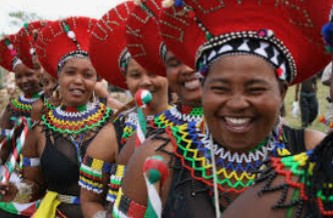
The culture in Africa varies and is numerous, consisting of a mixture of countries with various tribes that each have their own unique characteristics. It is a product of the diverse populations that today inhabit the African continent and the African Diaspora. African culture is expressed in its arts and crafts, folklore and religion, clothing, cuisine, music, human relational attitude and languages. Culture is abundantly expressed within the African continent Africa, with large amounts of cultural diversity being found not only across different countries but also within individual countries. Even though African cultures are widely diverse, they are also, when closely studied, seen to have many similarities and unique relational traits; for example, the morals they uphold, their love and respect for their culture as well as the strong respect they hold for the aged, the important, and the influential i.e traditional rulers/leaders, elites.
Other continents has influenced Africa. Likewise, Africa has been influenced by other continents. This can be seen in the willingness to adapt to the ever-changing modern world rather than staying rooted to their static culture. After all, dynamism cannot be ruled out of the beautiful attribute of life. The few that had being won over by the western way of life, persuaded by American culture and Christianity, first denied African traditional culture: but with the increase of African nationalism, a cultural recovery is taking place. The governments of most African nations encourage national dance and music groups, museums, and to a lower degree, artists and writers.
Having identified these about Africa and her people both current inhabitants and Africans in diaspora, it is also good to know that none Africans are interested in the African people and their culture. This is portrayed in the way westerner’s appreciate the African culture when they visit Africa. They come in contact with an element of the African culture either via internet or individuals that travel with them to other continents. These culture elements include language, dressing, hair styles (fashion), relational attitude (greetings) among others.
We use cookies on our website to give you the most relevant experience by remembering your preferences and repeat visits. By clicking “Accept”, you consent to the use of ALL the cookies.
This website uses cookies to improve your experience while you navigate through the website. Out of these, the cookies that are categorized as necessary are stored on your browser as they are essential for the working of basic functionalities of the website. We also use third-party cookies that help us analyze and understand how you use this website. These cookies will be stored in your browser only with your consent. You also have the option to opt-out of these cookies. But opting out of some of these cookies may affect your browsing experience.
Necessary cookies are absolutely essential for the website to function properly. This category only includes cookies that ensures basic functionalities and security features of the website. These cookies do not store any personal information.
Any cookies that may not be particularly necessary for the website to function and is used specifically to collect user personal data via analytics, ads, other embedded contents are termed as non-necessary cookies. It is mandatory to procure user consent prior to running these cookies on your website.