

Senegal has developed an important oyster industry in recent years that is still under-exploited although it is promising new revenues.
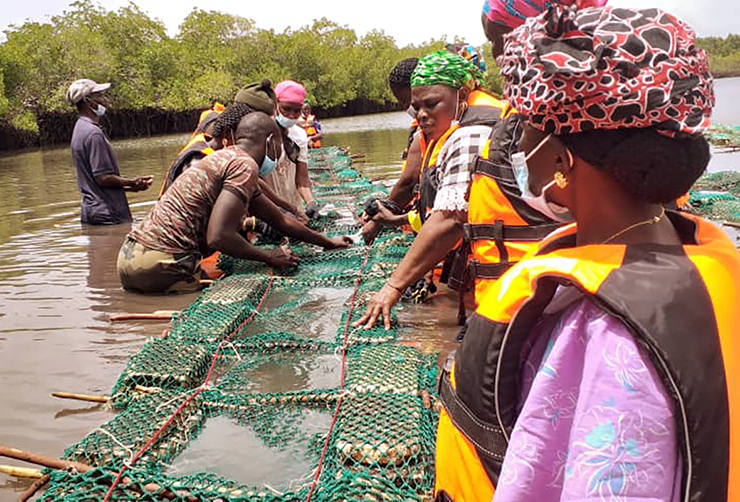
The mangrove swamp near Joal-Fadiouth, a fishing village in southern Senegal, teems with oysters but hunting for shellfish treasure among gnarly tree roots in brackish water is a lot of work.
Boubacar Banda Diop is in charge of oyster farming at the Ministry of Fisheries,and accoding to him, “Marketing is mainly informal, as the sector does not meet international sanitary requirements. So the little export that takes place is informal and limited to the sub-region, for a small quantity compared to the overall production.”
Thousands of people — the vast majority of them women — make a living from oysters in Senegal, usually at a small and informal level.
“The activity is definitely launched. We have doubled our production compared to last year. In 2021, we had 2 tons of oysters, this year we are at 4 tons. At the beginning, only foreigners consumed oysters but now, Senegalese are interested in the product and we have partnerships with hotel structures,” saidOusmane Fall, an oyster farmer.
In 2017, farmers plucked about 15,600 tonnes of oysters from Senegal’s mangroves, according to the United Nations Food and Agriculture Organization (FAO). They also gathered about 400 tonnes from oyster beds.
Senegal lags behind China world’s largest oyster producer that harvests about 3.5 million tonnes per year, according to the French research institute Ifremer.