


Kenya to receive $750 million from World Bank
The World Bank has approved a $750 million loan for Kenya, aimed at supporting the East African country’s 2022 budget. Kenya would have to carry out some necessary reforms in its …

Over 150 hectares of sugarcane fields have been destroyed in Cameroon due to violent clashes between workers at the Société Sucrière du Cameroun (SOSUCAM) and police. The unrest, which erupted earlier …
FIFA has announced the immediate suspension of the Congolese Football Federation (FECOFOOT), following escalating tensions between the Ministry of Sports and the football body. The dispute, which has been ongoing for …
A federal judge has delivered a major blow to President Donald Trump and his ally, billionaire Elon Musk, halting plans to pull thousands of staffers from the U.S. Agency for International …
The World Bank has approved a $750 million loan for Kenya, aimed at supporting the East African country’s 2022 budget. Kenya would have to carry out some necessary reforms in its …

On March 17 in Marseille, France, European and African political and economic leaders met for the Europe-Africa forum. Organized at the Palais du Pharo by the Metropole Aix-Marseille-Provence with the newspaper …
On March 17 in Marseille, France, European and African political and economic leaders met for the Europe-Africa forum.
Organized at the Palais du Pharo by the Metropole Aix-Marseille-Provence with the newspaper La Tribune and La Tribune Afrique, as a follow-up to the European Union-African Union summit held in Brussels on February 17 and 18. The main objective of this forum was to strengthen the new partnership between the two continents through a day of debates and discussions on various themes. Among them, the creation of employment and added value were discussed.

The Minister of Finance of the Democratic Republic of Congo, Nicolas Kazadi, spoke about entrepreneurship, which for him is “the job of tomorrow”: “There must be a change in mentality, especially among young people, in relation to the relationship between employees and employers. If this change is not made, if we are not culturally prepared to become entrepreneurs, we will be eternally frustrated, that’s what we still are today, and that’s what needs to change.”
Amina Zakhnouf, co-founder of the association “Je m’engage pour l’Afrique”, shares this need for a change of mentality: “We have been very unambitious about what we already have in terms of potential, and I would like us to stop talking about purely material potential, by talking about the resources of Africa and its youth, there are other things that exist on the continent that are exceptional. There is a technical and technological innovation on the Finetech point of view that could transform this continent into a real laboratory of ideas and give Africa a leading role in the drafting of a new regulation.”
African entrepreneurs are already established on the continent and are developing small and medium-sized businesses. Some of them are sometimes boosted by private companies.
The French bank La Société Générale, still positioned in several African countries such as Morocco, Ivory Coast, Senegal and Cameroon, offers solutions.
“The support of SMEs is key in Africa, particularly for the inclusion of populations and to fight against poverty. We intervene both in financing and we have decided to double our financing by 2025, and also with a lot of coaching of business leaders through the houses of the SME that we have organized in each of our banks on the African continent,” said Laurent Goutard, director of the Africa, Mediterranean & Overseas Region of Société Générale.
Several questions remain unanswered at the end of this forum, and among them, is how to find the right cooperation between public authorities and private companies.
The European and African political leaders present at the forum nevertheless showed a willingness to change the paradigm.

Rising prices driven by the Ukraine crises have stoked fear of devastating social turmoil in eastern DR Congo. In the region, the economy is hobbled by geographical remoteness and decades of …
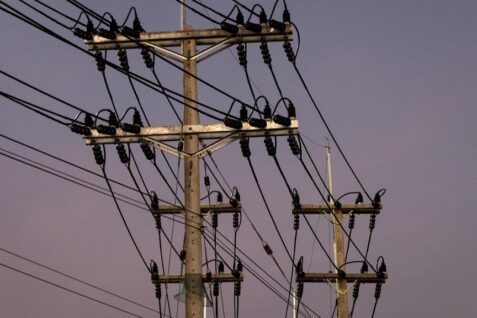
Sub-Saharan Africa would need an investment of $350 billion between now and 2030, to be able to improve electricity generation/distribution and potentially solve the region’s long-standing electricity access problem. This is …
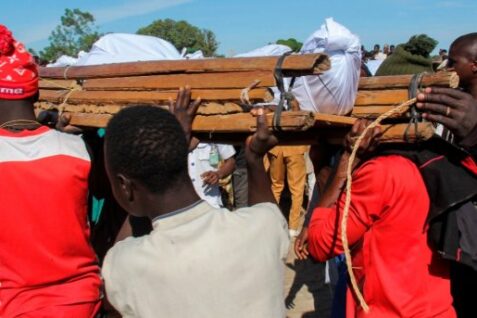
At least seven people, including four civilian auxiliaries enlisted in the fight against jihadism in Burkina Faso, were killed Monday in an attack in the north of the country, the fifth …
At least seven people, including four civilian auxiliaries enlisted in the fight against jihadism in Burkina Faso, were killed Monday in an attack in the north of the country, the fifth in a few days in the region.
“A security source told africa news guru: “Armed men attacked the drilling installations in Tonri Oulo, a locality in the commune of Arbinda in Soum province, in the morning of Monday.
“During the sabotage of the installations, they killed three civilians and wounded three others. Four elements of the VDP (Volunteers for the Defence of the Fatherland), who tried to counter the attackers were also killed,” bringing the death toll to “seven”, the same source said. The VDPs, poorly trained and poorly armed civilian auxiliaries of the army, are paying a heavy price in the fight against jihadism in Burkina Faso.
The attack was confirmed by a local official. “We have recorded about ten victims, including seven deaths,” the official confirmed, adding that “two other boreholes were sabotaged by the terrorists. “A few weeks ago they had already sabotaged the mobile phone installations, and now they are trying to asphyxiate the town by cutting off all supplies,” the source said.
Armed groups
This modus operandi confirms the strategy observed in recent weeks where armed jihadist groups are trying to occupy towns in the north and east of the country. “This consists of isolating strategic towns by cutting off access and communication routes. These towns serve as their rear base,” Mahamoudou Sawadogo, a researcher and expert on security issues in the Sahel, told Africa news guru.
In recent days, several deadly attacks have hit the region of Dori, one of the main towns in the northeast of the country, about 100 km from Arbinda. Some 23 civilians and 13 gendarmes have died in these attacks. This is the highest death toll since Lieutenant Colonel Paul-Henri Sandaogo Damiba took office in Burkina Faso on 24 January and overthrew President Roch Marc Christian Kaboré, who is often accused of being ineffective in the face of attacks.
In the wake of Mali and Niger, Burkina Faso has been caught up in a spiral of violence since 2015, attributed to jihadist movements affiliated to al-Qaeda and the Islamic State group, which have killed more than 2,000 people in the country and forced at least 1.7 million people to flee their homes.
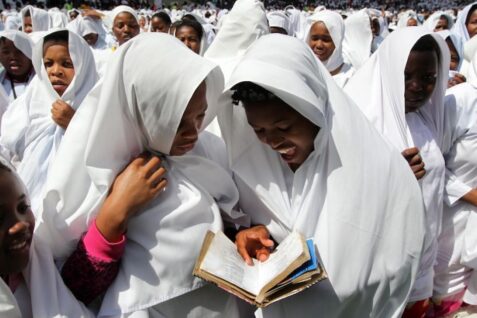
Israel is reportedly banning the entry of Ethiopian pilgrims who want to embark on a pilgrimage to the country during this year’s Easter for fear they will not return home. Local …
Israel is reportedly banning the entry of Ethiopian pilgrims who want to embark on a pilgrimage to the country during this year’s Easter for fear they will not return home.
Local media reports travel and tour companies have received a letter from Israel’s Population and Immigration Authority stating that any Ethiopian traveller who wants to visit Israel will need to contact the authority personally and receive permission to enter.
Tourists from other countries do not have to follow this same protocol; tour companies can generally submit a group application for tourists travelling as a group.

The authority’s letter noted that the move was out of concern that “these tourists will not head back” due to the ongoing civil war in their country, according to local media reports.
Israel’s Population and Immigration Authority said the policy was necessary because in the past Ethiopian tourists have overstayed.
The head of the Israel Incoming Tour Operators Association is quoted by the Times of Israel as saying it was “severely discriminatory” as it only applied to Ethiopians.
The Tigray War began in November 2020.
A spokesperson for Ethiopia’s foreign ministry says that he was not aware of the decision by Israel.
Ethiopia’s tourism sector has also been hit hard by the fighting, as many of the country’s most-celebrated destinations are unreachable.
One tour operator in Addis Ababa, which works with counterparts in Israel to arrange the pilgrimages, says that the decision was bad news for his business already suffering from the war and pandemic-related restrictions.

South African adventure cyclists Ron Rutland and Adam Nunn are already on their way to Auckland in New Zealand to deliver the whistle for the opening match of Rugby World Cup …
South African adventure cyclists Ron Rutland and Adam Nunn are already on their way to Auckland in New Zealand to deliver the whistle for the opening match of Rugby World Cup 2021, playing 2022 and to raise money for charity.
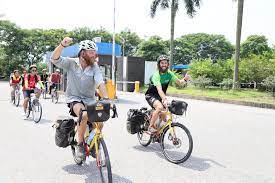
For one of the cyclists the motivation is to promote womens sports.
“So just motivates me every pedal stroke that we put in the women’s game on the map, we put in women sports on the map. We are raising money for a charity that’s going to put women out of certain problems and issues that they have in the world, and it’s just an amazing cause”, said South African adventure cyclist, Adam Nunn.
The journey of 16,500 kms started in Tokyo and will end in New Zealand before the match between South Africa and France. The two men will cycle through 14 countries across 210 days.
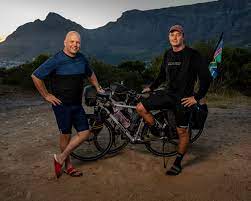
“I think some of the most I mean, it’s been very challenging just getting to the start line this year, obviously a lot of challenges in the world with with COVID-19. So it’s been really difficult putting this trip together and even getting to Japan, but we’re very grateful to be here now. And I think on every journey, getting to the start line is probably the most difficult thing”, admits Ron Rutland.
The pair also aim to raise funds for ChildFund Rugby, the Principal Charity Partner of Rugby World Cup 2021 by encouraging fans to sponsor a kilometre.
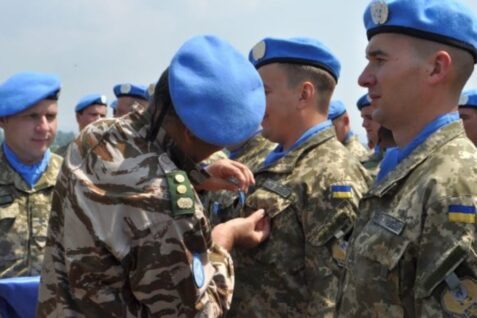
A contingent of 250 Ukrainian peacekeepers are to leave eastern DRC and return to Ukraine. The announcement was made on Tuesday by the UN. A date is yet to be announced …
A contingent of 250 Ukrainian peacekeepers are to leave eastern DRC and return to Ukraine.
The announcement was made on Tuesday by the UN.
A date is yet to be announced for the departure. The withdrawal will also include equiment and helicopters.
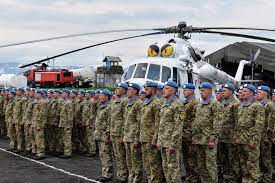
“If they are leaving to strengthen forces at home because things have heated up lately, I must say that it is not a problem at all. They can leave to find a solution at home because it’s not important to be with us in the DRC, while things are burning at home”, said a local resident, Rede Kibanda.
“We will continue to pray for them for this war to end, because everything that has a beginning has an end. We don’t want this war to persist, even if at home in the DRC the war continues, but we don’t want that. With the help of God this war will end”, added Justin Maheshe, a local vendor.
Goma is in the eastern part of DRC and has been plagued by violence from dozens of armed groups for more than 20 years.
The Senegalese President Macky Sall, who is also the current chairman of the African Union (AU), Wednesday had a phone conversation with his Russian counterpart Vladimir Putin to “seek a lasting …
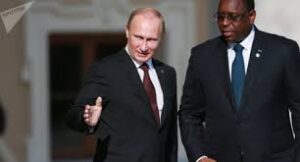
The Senegalese President Macky Sall, who is also the current chairman of the African Union (AU), Wednesday had a phone conversation with his Russian counterpart Vladimir Putin to “seek a lasting ceasefire” in Ukraine.
The African Union had, in a statement issued on 24 February, called on Russia and “any other regional or international actor to imperatively respect international law, territorial integrity and national sovereignty of Ukraine”.
He had urged Russia and Ukraine for an immediate ceasefire and the opening of negotiations with the help of the UN.
Senegal, which has strong relations with Western countries, surprised the international community on 2 March by abstaining in a UN General Assembly vote in favor of a resolution that “demands that Russia immediately ceases the use of force against Ukraine”.
Meanwhile, Ukraine has told the UN it will repatriate its 250 peacekeepers deployed in the Democratic Republic of Congo.
The withdrawal will include all its military contingent, including personnel, helicopters and equipment from the UN peacekeeping mission in the Democratic Republic of Congo (Monusco).
Ukraine also has a military presence in other UN peace missions around the world: 16 personnel in South Sudan, 12 in Mali, 5 in Cyprus, 4 in Abyei in Sudan and 3 in Kosovo, according to the UN.

The Libyan Transitional Council of Ministers headed by Abdelhamid Dbeibah has suspended the implementation of an agreement with the United Nations on gender equality. The decision was taken on the eve …


